ToolChase Data Study
The State of AI Tools 2026
We analyzed every active tool in the ToolChase directory, 724 AI tools across 31 categories, then layered in independent search demand and two months of market churn. Here is what the mid-2026 AI tool market actually looks like: how tools charge, what people search for, and which products did not survive the summer.
Most AI tools are freemium, few are truly free
Across 724 active tools, the freemium model dominates: 53% (386 tools) give you a limited free tier and charge for more, including names like ChatGPT, Claude, Canva, Gamma. Only 6% (44 tools) are genuinely free or open source with no paid upsell, such as Google Translate AI, DuckDuckGo AI Chat, Aider. A further 36% (260) are paid-only, like Midjourney, Jasper, Surfer SEO, Moz, and 5% (34) sell only on enterprise or custom terms. The split has barely moved since our June edition even as the tool set churned underneath it, which suggests these ratios are structural, not accidental.
Source: ToolChase editorial dataset, 724 active tools, pricing model classified from current vendor plans (August 2026).
What a leading AI tool actually costs
For all the talk of expensive AI, the flagship consumer tools hold one price. The big assistants, ChatGPT, Claude, Perplexity AI and Cursor, all land at exactly $20 a month, with Gemini a cent under at $19.99, and Notion joined the club by moving its AI into the $20 Business plan. Creative tools sit lower at $10 to $15. The new 2026 move is underneath that line: vendors are adding cheap lite tiers, ChatGPT Go at $6, Gemini Plus at $4.99, ElevenLabs Starter at $6, so a serious AI subscription now costs about the same as one streaming service, and a casual one costs less than lunch.
Source: ToolChase verified pricing, entry paid plan (the main consumer tier) for each tool, August 2026. For Notion the plan shown is the one that includes Notion AI. Higher tiers, lite tiers, and usage-based pricing not shown.
Does paying more get you a better tool?
Not really, and this is the most useful thing in the whole study. When we average our editorial scores by pricing model, the four groups are nearly identical, and the ordering is upside down: free tools average 4.37, freemium and enterprise 4.34, and paid-only tools come in last at 4.28. That gap widened slightly since June. A bigger price tag is not a reliable signal of a better tool, and the best free and freemium tools hold their own against anything paid.
Average ToolChase editorial score (1 to 5) by pricing model, August 2026. Bar scale starts at 4.0 to show the small differences. Source: ToolChase editorial dataset, 685 scored tools.
What people actually search for
Independent search data tells you where real demand sits. ChatGPT is still in a league of its own at roughly 30M US searches a month, about 10x the next-biggest AI tool. The pack behind it reshuffled since June: Google Gemini now leads it, Claude joined Grammarly in seven figures, and video and voice tools like HeyGen and ElevenLabs pushed past several older names.
Source: Ahrefs Keywords Explorer, United States monthly search volume, August 2026. ChatGPT (30.0M/mo) excluded from the chart as an outlier. Volumes are not comparable to the June edition because Ahrefs recalibrated its volume model in between.
Download and share this study
Free to use and cite with a link to ToolChase. Grab the full PDF report, the shareable infographic, or the raw dataset behind every chart on this page.
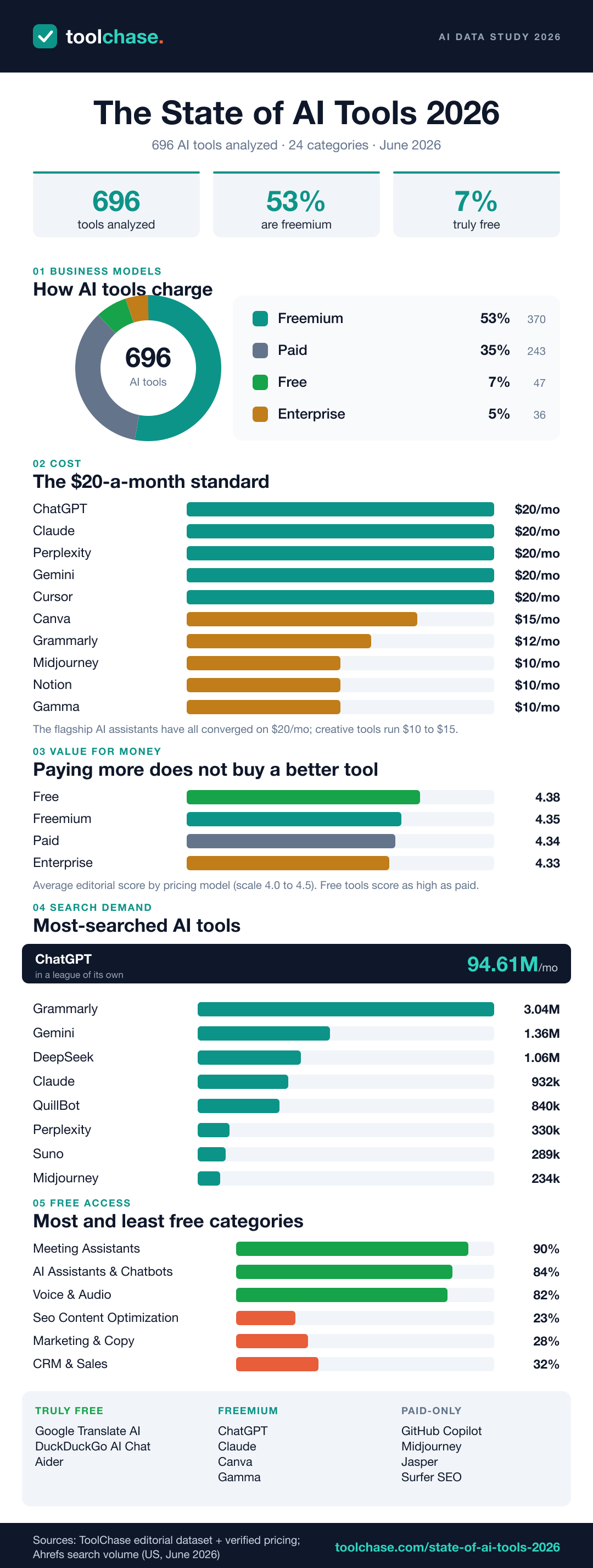
Which AI categories are most (and least) free
Free access is not evenly distributed. Consumer-facing categories lean heavily free, while categories that sell to businesses gate access behind paid plans. Voice, meeting, and image tools are the most generous; healthcare, SEO, and marketing tools are the least. Healthcare is the extreme case: it sells to clinics and hospitals, not consumers, and only one tool in the category has any free tier.
Most free (share of tools with a free tier)
Least free
Source: ToolChase editorial dataset, August 2026, categories with 15 or more active tools. Free share = tools classified Free or Freemium.
How the pricing mix shifts by category
The same four business models split very differently across categories. Voice, image and video tools are overwhelmingly freemium, chatbots carry the most genuinely free options, and marketing and sales tools are mostly paid-only. Each bar is the full mix for one of the eight largest categories.
Source: ToolChase editorial dataset, August 2026, the eight largest categories (36 or more active tools each).
The AI tool landscape by category
AI assistants and chatbots now form the largest category, followed by marketing and video tools. One honest caveat: in July we split the old catch-all Productivity group into finer categories (note-taking, meetings, documents, website builders, data analysis and more), so these counts are not comparable to the June edition. Tool counts for the 10 biggest categories:
Source: ToolChase directory, primary category per active tool (August 2026).
The highest-rated AI categories
Quality is high everywhere, but some categories edge ahead. Automation, sales, meeting, and coding tools post the strongest average scores, while every category with 20 or more scored tools averages 4.2 or higher out of 5. Each category also has a clear standout.
Average ToolChase editorial score by category (categories with 20+ scored tools), August 2026. Bar scale starts at 4.0. Source: ToolChase editorial dataset.
How good are these tools?
Using ToolChase editorial scores (a 1 to 5 scale based on capability, value, and reliability, not user-submitted ratings), the average tool scores 4.32 out of 5, with a median of 4.3, and 95% score 4.0 or higher. That share was 98% in June: as the directory widens, we are scoring more tools below 4.0 (36 now versus 12 then) rather than only listing safe picks. 685 of the 724 active tools carry a score; 39 recent additions are still in scoring.
Distribution of ToolChase editorial scores across the 685 scored active tools, August 2026. See our scoring methodology.
The AI tool graveyard: what died since June
The market is growing and shrinking at the same time. The directory expanded from 696 analyzed tools in June to 724 active tools today, yet in those same eight weeks 16 products we tracked were discontinued, absorbed, or changed beyond recognition, roughly one in forty-six. That is the quiet risk of building a workflow on a young AI tool, and it is why every discontinued product keeps its page on ToolChase with a warning banner and a hand-picked list of alternatives. Tap any name for replacements:
Source: ToolChase directory change log, June 18 to August 16, 2026. Status labels are taken from each product page. Excludes 14 listings merged as duplicates and earlier shutdowns.
Free to reference with a link back to ToolChase. Suggested citation:
ToolChase (2026). The State of AI Tools 2026: Pricing, Free Tiers, and Search Demand. https://toolchase.com/state-of-ai-tools-2026/
Methodology
This edition covers the 724 active AI tools indexed in the ToolChase directory as of August 16, 2026, spanning 31 primary categories (the browse hub organizes 32, one of which currently maps tools whose primary category lies elsewhere). Active means the tool is live and indexable: we excluded 39 pages kept online for products that have been discontinued, 6 delisted legacy pages, and 14 listings merged as duplicates. Pricing model is classified from each tool's current vendor plans into Free (no paid tier, including open source), Freemium (a listed $0 plan or edition you can keep, whether its allowance refreshes or is a one-time credit grant), Paid (time-limited trials or preview-only access do not count as a free tier), or Enterprise/Custom (sales-quoted only), and verified against official vendor pages on a rolling basis. Quality uses ToolChase editorial scores, not user reviews. Entry prices in the cost chart are each tool's main consumer paid tier, verified directly from the vendor (August 2026); higher tiers and usage-based pricing are not shown. Average score by pricing model and by category uses ToolChase editorial scores; 685 of the 724 active tools are scored and 39 recent additions are not yet scored. Search demand is United States monthly search volume from Ahrefs Keywords Explorer, August 2026; Ahrefs recalibrated its volume model after June, so demand figures are not comparable across editions. Category counts are likewise not comparable to June: the directory's category system was refined from 24 broad groups into 31 finer ones in July. Churn is measured from directory change history between the June 18 edition and August 16, 2026. All figures are point-in-time and will shift as vendors change plans and demand moves. The full per-tool dataset (name, category, pricing model, editorial score) is downloadable as CSV above. Every tool in this sample entered the directory at no charge to its vendor and was scored before any commercial conversation. From 25 August 2026 a vendor can also buy review access for a tool that is not yet indexed, which buys an editor's time and nothing else; no tool in this edition entered that way, and any future edition drawing on paid entries will say so here.
Frequently asked questions
How many AI tools are there in 2026?
The broader market counts tens of thousands of AI products, but ToolChase actively tracks and hand-verifies 724 AI tools across 31 categories as of August 2026. That number moves constantly: 16 tracked tools were discontinued or absorbed between mid-June and mid-August alone.
What percentage of AI tools are free?
Only 6% are truly free with no paid tier. 53% are freemium, 36% are paid-only, and 5% sell on enterprise or custom terms, so 59% offer some form of free access. The full breakdown is in our free-vs-paid deep dive.
How much does a leading AI tool cost per month?
The flagship assistants (ChatGPT, Claude, Perplexity, Cursor) all charge $20 a month, with Gemini at $19.99. Creative tools run $10 to $15, and 2026 brought sub-$10 lite tiers like ChatGPT Go ($6) and Gemini Plus ($4.99).
Which AI tools are popular and which are niche?
Scale differs by orders of magnitude. In US search demand, ChatGPT stands alone at roughly 30M monthly searches, a second tier (Gemini, Grammarly, Claude) clears 1M, and most specialist tools sit between 50k and 300k. By directory footprint, assistants and chatbots form the largest category (62 tools) while focused niches like AI detectors and code quality have fewer than 10 each. The full breakdown is in sections 4 and 7 above, and the monthly changelog tracks which new tools survive.
Are paid AI tools better than free ones?
Not on average. Editorial scores are nearly identical across pricing models, and paid-only tools currently average the lowest of the four groups (4.28 versus 4.37 for free tools). Price is not a quality signal.
Explore the underlying data: all 724 active AI tools, browse by category, or compare tools head to head in the comparison hub.